Grit
Chapter 1:
Showing up
Who are the people at the very top of your field? What are they like? What do you think makes them special?
Apparently, it was critically important—and not at all easy—to keep going after failure:
The highly accomplished were paragons of perseverance.
In sum, no matter the domain, the highly successful had a kind of ferocious determination that played out in two ways. First, these exemplars were unusually resilient and hardworking. Second, they knew in a very, very deep way what it was they wanted. They not only had determination, they had direction .
It was this combination of passion and perseverance that made high achievers special. In a word, they had grit.
Half of the questions were about perseverance. They asked how much you agree with statements like “I have overcome setbacks to conquer an important challenge” and “I finish whatever I begin.” The other half of the questions were about passion. They asked whether your “interests change from year to year” and the extent to which you “have been obsessed with a certain idea or project for a short time but later lost interest.” What emerged was the Grit Scale—a test that, when taken honestly, measures the extent to which you approach life with grit.
Our potential is one thing. What we do with it is quite another.
Chapter 2:
Distracted by talent
I’d been distracted by talent.
I began to reflect on how smart even my weakest students sounded when they talked about things that genuinely interested them.
The normal response to being puzzled about something is to say, “I’ll think about this later,” and then, in effect, forget about it. With Darwin, one feels that he deliberately did not engage in this kind of semi-willful forgetting. He kept all the questions alive at the back of his mind, ready to be retrieved when a relevant bit of data presented itself.
James observed: Compared with what we ought to be, we are only half awake. Our fires are damped, our drafts are checked. We are making use of only a small part of our possible mental and physical resources.
James asserted that “the human individual lives usually far within his limits; he possesses powers of various sorts which he habitually fails to use. He energizes below his maximum, and he behaves below his optimum.”
So, why do we place such emphasis on talent? And why fixate on the extreme limits of what we might do when, in fact, most of us are at the very beginning of our journey, so far, far away from those outer bounds? And why do we assume that it is our talent, rather than our effort, that will decide where we end up in the very long run?
What we say we care about may not correspond with what—deep down—we actually believe to be more valuable. It’s a little like saying we don’t care at all about physical attractiveness in a romantic partner and then, when it comes to actually choosing whom to date, picking the cute guy over the nice one.
The “naturalness bias” is a hidden prejudice against those who’ve achieved what they have because they worked for it, and a hidden preference for those whom we think arrived at their place in life because they’re naturally talented. We may not admit to others this bias for naturals; we may not even admit it to ourselves. But the bias is evident in the choices we make.
talent is the sum of a person’s abilities—his or her intrinsic gifts, skills, knowledge, experience, intelligence, judgment, attitude, character, and drive. It also includes his or her ability to learn and grow.”
In my view, the biggest reason a preoccupation with talent can be harmful is simple: By shining our spotlight on talent, we risk leaving everything else in the shadows. We inadvertently send the message that these other factors—including grit—don’t matter as much as they really do.
another conclusion is that the focus on talent distracts us from something that is at least as important, and that is effort
Chapter 3
Efforts count twice
“Talent,” he observed, “is perhaps the most pervasive lay explanation we have for athletic success.” It is as if talent were some invisible “substance behind the surface reality of performance, which finally distinguishes the best among our athletes.” And these great athletes seem blessed “with a special gift, almost a ‘thing’ inside of them, denied to the rest of us—perhaps physical, genetic, psychological, or physiological. Some have ‘it,’ and some don’t. Some are ‘natural athletes,’ and some aren’t.”
what is the reality of greatness? Nietzsche came to the same conclusion Dan Chambliss did. Great things are accomplished by those “people whose thinking is active in one direction, who employ everything as material, who always zealously observe their own inner life and that of others, who perceive everywhere models and incentives, who never tire of combining together the means available to them.”
And what about talent? Nietzsche implored us to consider exemplars to be, above all else, craftsmen: “Do not talk about giftedness, inborn talents! One can name great men of all kinds who were very little gifted. They acquired greatness, became ‘geniuses’ (as we put it). . . . They all possessed that seriousness of the efficient workman which first learns to construct the parts properly before it ventures to fashion a great whole; they allowed themselves time for it, because they took more pleasure in making the little, secondary things well than in the effect of a dazzling whole.”
Talent is how quickly your skills improve when you invest effort. Achievement is what happens when you take your acquired skills and use them. Of course, your opportunities—for example, having a great coach or teacher—matter tremendously, too, and maybe more than anything about the individual.
Talent—how fast we improve in skill—absolutely matters. But effort factors into the calculations twice , not once. Effort builds skill. At the very same time, effort makes skill productive
talent x effort = skill
At the same time, the number of good pots he’s brought into the world increased:
skill x effort = achievement
Grammy Award–winning musician and Oscar-nominated actor Will Smith has thought a lot about talent, effort, skill, and achievement. “I’ve never really viewed myself as particularly talented,” he once observed. “Where I excel is ridiculous, sickening work ethic.”
When it comes to how we fare in the marathon of life, effort counts tremendously.
Allen’s snappier formulation, “Eighty percent of success in life is showing up.”
Many of us, it seems, quit what we start far too early and far too often. Even more than the effort a gritty person puts in on a single day, what matters is that they wake up the next day, and the next, ready to get on that treadmill and keep going
“The separation of talent and skill,” Will Smith points out, “is one of the greatest misunderstood concepts for people who are trying to excel, who have dreams, who want to do things. Talent you have naturally. Skill is only developed by hours and hours and hours of beating on your craft.”
Without effort, your talent is nothing more than your unmet potential. Without effort, your skill is nothing more than what you could have done but didn’t. With effort, talent becomes skill and, at the very same time, effort makes skill productive .
Chapter 4
How gritty are you
Enthusiasm is common. Endurance is rare.
Pete’s philosophy is: Do things better than they have ever been done before
Here are a few ways a lack of grit can show itself. I’ve met many young people who can articulate a dream—for example, to be a doctor or to play basketball in the NBA—and can vividly imagine how wonderful that would be, but they can’t point to the mid-level and lower-level goals that will get them there. Their goal hierarchy has a top-level goal but no supporting mid-level or low-level goals:
“positive fantasizing.” Gabriele’s research suggests that indulging in visions of a positive future without figuring out how to get there, chiefly by considering what obstacles stand in the way, has short-term payoffs but long-term costs. In the short-term, you feel pretty great about your aspiration to be a doctor. In the long-term, you live with the disappointment of not having achieved your goal.
First, you write down a list of twenty-five career goals. Second, you do some soul-searching and circle the five highest-priority goals. Just five. Third, you take a good hard look at the twenty goals you didn’t circle.
Any successful person has to decide what to do in part by deciding what not to do.
One of the mottos of the Green Berets is: “Improvise, adapt, overcome.” A lot of us were told as children, “If at first you don’t succeed, try, try again.” Sound advice, but as they say “try, try again, then try something different.” At lower levels of a goal hierarchy, that’s exactly what’s needed
The one thing all the cartoons had in common was this: they made the reader think . And here was another common thread: every cartoonist had a personal style that was distinctively their own. There was no single “best” style. On the contrary, what mattered was that style was, in some very deep and idiosyncratic way, an expression of the individual cartoonist.
Bob advises aspiring cartoonists to submit their drawings in batches of ten, “because in cartooning, as in life, nine out of ten things never work out.”
Indeed, giving up on lower-level goals is not only forgivable, it’s sometimes absolutely necessary. You should give up when one lower-level goal can be swapped for another that is more feasible. It also makes sense to switch your path when a different lower-level goal—a different means to the same end—is just more efficient, or more fun, or for whatever reason makes more sense than your original plan. On any long journey, detours are to be expected. However, the higher-level the goal, the more it makes sense to be stubborn.
with extroversion, cheerfulness, or sense of humor. And not all the high achievers had earned high marks in school. Rather, what definitively set apart the eminent from the rest of humanity were a cluster of four indicators. Notably, these also distinguished the First Ten from the Last Ten—the super-eminent from the merely eminent. Cox grouped these together and called them “persistence of motive.”
Two indicators could easily be rephrased as passion items for the Grit Scale. Degree to which he works with distant objects in view (as opposed to living from hand to mouth). Active preparation for later life. Working toward a definite goal. Tendency not to abandon tasks from mere changeability. Not seeking something fresh because of novelty. Not “looking for a change.” And the other two could easily be rewritten as perseverance items for the Grit Scale. Degree of strength of will or perseverance. Quiet determination to stick to a course once decided upon. Tendency not to abandon tasks in the face of obstacles. Perseverance, tenacity, doggedness.
“high but not the highest intelligence, combined with the greatest degree of persistence, will achieve greater eminence than the highest degree of intelligence with somewhat less persistence.”
Chapter 5
Grit grows
First: grit, talent, and all other psychological traits relevant to success in life are influenced by genes and also by experience.
Second: there’s no single gene for grit, or indeed any other psychological trait.
third, important point: heritability estimates explain why people differ from the average, but they say nothing about the average itself.
Flynn effect refers to startling gains in IQ scores over the past century. How big are the gains? On the most widely used IQ tests today—the Wechsler Intelligence Scale for Children and the Wechsler Adult Intelligence Scale—gains have averaged more than fifteen points in the last fifty years in the more than thirty countries that have been studied. Put another way, if you scored people a century ago against modern norms, they would have an average IQ score of 70—borderline for mentally retarded. If you scored people today against the norms of a century ago, we would have an average IQ score of 130—the typical cut score for mentally gifted programs.
reason we change is that we learn something we simply didn’t know before. For instance, we might learn through trial and error that repeatedly swapping out one career ambition for another is unfulfilling.
also learned that years of hard work are often mistaken for innate talent, and that passion is as necessary as perseverance to world-class excellence.
What changes, I think, are our circumstances. As we grow older, we’re thrust into new situations. We get our first job. We may get married. Our parents get older, and we find ourselves their caretakers. Often, these new situations call on us to act differently than we used to. And, because there’s no species on the planet more adaptable than ours, we change. We rise to the occasion.
Necessity is the mother of adaptation.
Lectures don’t have half the effect of consequences. What the maturity principle comes down to, I think, is this. Over time, we learn life lessons we don’t forget, and we adapt in response to the growing demands of our circumstances. Eventually, new ways of thinking and acting become habitual. There comes a day when we can hardly remember our immature former selves. We’ve adapted, those adaptations have become durable, and, finally, our identity—the sort of person we see ourselves to be—has evolved. We’ve matured.
Like every aspect of your psychological character, grit is more plastic than you might think.
They desperately want a long-term goal, and they want to pursue that goal with passion and perseverance. But they don’t know where to begin. A good place to start is to understand where you are today. If you’re not as gritty as you want to be, ask yourself why .
First comes interest . Passion begins with intrinsically enjoying what you do.
Next comes the capacity to practice . One form of perseverance is the daily discipline of trying to do things better than we did yesterday.
To be gritty is to resist complacency. “Whatever it takes, I want to improve!” is a refrain of all paragons of grit, no matter their particular interest, and no matter how excellent they already are.
Third is purpose . What ripens passion is the conviction that your work matters.
And, finally, hope . Hope is a rising-to-the-occasion kind of perseverance.
At various points, in big ways and small, we get knocked down. If we stay down, grit loses. If we get up, grit prevails.
Chapter 6
Interest
“My advice for you is, figure out what you enjoy doing most in life, and then try to do it full-time. Life is short. Follow your passion.”
“Whatever it is that you want to do, you’ll find in life that if you’re not passionate about what it is you’re working on, you won’t be able to stick with it.”
“What drives you on?” and “If you lost everything tomorrow, what would you do?”
Follow your passion was not the message I heard growing up. Instead, I was told that the practical realities of surviving “in the real world” were far more important than any young person living a “sheltered life” such as my own could imagine. I was warned that overly idealistic dreams of “finding something I loved” could in fact be a breadcrumb trail into poverty and disappointment. I was reminded that certain jobs, like being a doctor, were both high-income and high-status, and that these things would matter more to me in the long run than I might appreciate in the moment.
First, research shows that people are enormously more satisfied with their jobs when they do something that fits their personal interests
Second, people perform better at work when what they do interests them.
Like it or not, there are very real constraints in the choices we can make about how we earn a living.
Barry thinks that what prevents a lot of young people from developing a serious career interest is unrealistic expectations. “It’s really the same problem a lot of young people have finding a romantic partner,” he said. “They want somebody who’s really attractive and smart and kind and empathetic and thoughtful and funny. Try telling a twenty-one-year-old that you can’t find a person who is absolutely the best in every way. They don’t listen. They’re holding out for perfection.
passion for your work is a little bit of discovery , followed by a lot of development , and then a lifetime of deepening .
First of all, childhood is generally far too early to know what we want to be when we grow up
Second, interests are not discovered through introspection. Instead, interests are triggered by interactions with the outside world. The process of interest discovery can be messy, serendipitous, and inefficient. This is because you can’t really predict with certainty what will capture your attention and what won’t. You can’t simply will yourself to like things, either.
Jeff Bezos has observed, “One of the huge mistakes people make is that they try to force an interest on themselves.” Without experimenting, you can’t figure out which interests will stick, and which won’t.
Third, what follows the initial discovery of an interest is a much lengthier and increasingly proactive period of interest development
Finally, interests thrive when there is a crew of encouraging supporters, including parents, teachers, coaches, and peers.
the reality is that our early interests are fragile, vaguely defined, and in need of energetic, years-long cultivation and refinement.
we all know people who habitually throw themselves headlong into a new project, developing a fierce interest, only to move on after three or four or five years to something entirely different. There seems no harm in pursuing a variety of different hobbies, but endlessly dating new occupations, and never settling down with just one, is a more serious matter. “I call them short-termers,” Jane Golden told me.
Fundamentally, the emotion of boredom, after doing something for a while, is a very natural reaction. All human beings, even from infancy, tend to look away from things they’ve already seen and, instead, turn their gaze to things that are new and surprising. In fact, the word interest comes from the Latin interesse , which means “to differ.” To be interesting is, literally, to be different. We are, by our natures, neophiles.
grit paragons don’t just discover something they enjoy and develop that interest—they also learn to deepen it.
novelty for the expert in another. For the beginner, novelty is anything that hasn’t been encountered before. For the expert, novelty is nuance.
If you’d like to follow your passion but haven’t yet fostered one, you must begin at the beginning: discovery. Ask yourself a few simple questions: What do I like to think about? Where does my mind wander? What do I really care about? What matters most to me? How do I enjoy spending my time? And, in contrast, what do I find absolutely unbearable?
Whatever your age, over time your role as a learner will become a more active and informed one. Over a period of years, your knowledge and expertise will grow, and along with it your confidence and curiosity to know more.
the directive to follow your passion is not bad advice. But what may be even more useful is to understand how passions are fostered in the first place.
Chapter 7
Practice
My interview research made me wonder whether grit is not just about quantity of time devoted to interests, but also quality of time. Not just more time on task , but also better time on task .
This is how experts practice: First, they set a stretch goal, zeroing in on just one narrow aspect of their overall performance. Rather than focus on what they already do well, experts strive to improve specific weaknesses. They intentionally seek out challenges they can’t yet meet.
The active processing of this feedback is as essential as its immediacy.
magician David Blaine did when he held his breath underwater for seventeen minutes, watch his TED talk
world-class performers who retire tend not to keep up nearly the same deliberate practice schedule. If practice was intrinsically pleasurable—enjoyable for its own sake—you’d expect them to keep doing it.
deliberate practice is carefully planned, and flow is spontaneous. Because deliberate practice requires working where challenges exceed skill, and flow is most commonly experienced when challenge and skill are in balance. And, most important, because deliberate practice is exceptionally effortful, and flow is, by definition, effortless.
Csikszentmihalyi has published a contrary opinion: “Researchers who study the development of talents have concluded that to learn any complex skill well takes about 10,000 hours of practice. . . . And the practice can be very boring and unpleasant. While this state of affairs is all too often true, the consequences are by no means self-evident.” Csikszentmihalyi goes on to share a personal story that helps explain his perspective. In Hungary, where he grew up, on the tall wooden gate at the entrance to the local elementary school, hung a sign that read: The roots of knowledge are bitter, but its fruits are sweet. This always struck him as deeply untrue: “Even when the learning is hard,” he writes, “it is not bitter when you feel that it is worth having, that you can master it, that practicing what you learned will express who you are and help you achieve what you desire.”
grittier adults reported experiencing more flow, not less. In other words, flow and grit go hand in hand.
Gritty people do more deliberate practice and experience more flow . There’s no contradiction here, for two reasons. First, deliberate practice is a behavior, and flow is an experience
Second, you don’t have to be doing deliberate practice and experiencing flow at the same time. And, in fact, I think that for most experts, they rarely go together.
the primary motivation for doing effortful deliberate practice is to improve your skill. You’re concentrating one hundred percent, and you’ve deliberately set the level of challenge to exceed your current level of skill. You’re in “problem solving” mode, analyzing everything you do to bring it closer to the ideal—the goal you set at the beginning of the practice session. You’re getting feedback, and a lot of that feedback is about what you’re doing wrong, and you’re using that feedback to make adjustments and try again. The motivation that predominates during flow, in contrast, is entirely different. The flow state is intrinsically pleasurable. You don’t care whether you’re improving some narrow aspect of your skill set. And though you’re concentrating one hundred percent, you’re not at all in “problem solving” mode. You’re not analyzing what you’re doing; you’re just doing. You’re getting feedback, but because the level of challenge just meets your current level of skill, that feedback is telling you that you’re doing a lot right. You feel like you’re in complete control, because you are. You’re floating. You lose track of time. No matter how fast you’re running or how intensely you’re thinking, when you’re in flow, everything feels effortless
deliberate practice is for preparation, and flow is for performance.
Olympic gold medalist rower Mads Rasmussen offered a similar account of his motivation: “ It’s about hard work. When it’s not fun, you do what you need to do anyway. Because when you achieve results, it’s incredibly fun. You get to enjoy the ‘Aha’ at the end, and that is what drags you along a lot of the way.”
Nobody wants to show you the hours and hours of becoming. They’d rather show the highlight of what they’ve become.
the experience of deliberate practice can be extremely positive—not just in the long-term but in the moment. Fun isn’t quite the word they use to describe deliberate practice, but neither is bitter . And, too, top performers point out that the alternative to deliberate practice—mindlessly “going through the motions” without improvement—can be its own form of suffering.
there are different kinds of positive experience: the thrill of getting better is one, and the ecstasy of performing at your best is another.
Each of the basic requirements of deliberate practice is unremarkable: • A clearly defined stretch goal • Full concentration and effort • Immediate and informative feedback • Repetition with reflection and refinement
hidden behind every effortless performance on YouTube are hours and hours of unrecorded, invisible-to-outsiders, challenging, effortful, mistake-ridden practice. We told them that trying to do things they can’t yet do, failing, and learning what they need to do differently is exactly the way experts practice.
second suggestion for getting the most out of deliberate practice: Make it a habit . By this I mean, figure out when and where you’re most comfortable doing deliberate practice. Once you’ve made your selection, do deliberate practice then and there every day.
My third suggestion for getting the most out of deliberate practice is to change the way you experience it .
“Deliberate practice can feel wonderful,” Terry told me. “If you try, you can learn to embrace challenge rather than fear it. You can do all the things you’re supposed to do during deliberate practice—a clear goal, feedback, all of it—and still feel great while you’re doing it. “It’s all about in-the-moment self-awareness without judgment ,” he continued. “It’s about relieving yourself of the judgment that gets in the way of enjoying the challenge.”
According to Elena and Deborah, around the time children enter kindergarten, they begin to notice that their mistakes inspire certain reactions in grown-ups. What do we do? We frown. Our cheeks flush a bit. We rush over to our little ones to point out that they’ve done something wrong . And what’s the lesson we’re teaching? Embarrassment. Fear. Shame.
Chapter 8:
Purpose
Interest is one source of passion. Purpose—the intention to contribute to the well-being of others—is another. The mature passions of gritty people depend on both.
the more common sequence is to start out with a relatively self-oriented interest, then learn self-disciplined practice, and, finally, integrate that work with an other-centered purpose.
the long days and evenings of toil, the setbacks and disappointments and struggle, the sacrifice—all this is worth it because, ultimately, their efforts pay dividends to other people .
At its core, the idea of purpose is the idea that what we do matters to people other than ourselves.
On one hand, human beings seek pleasure
To some extent, all of us are, as Freud put it, driven by the “ pleasure principle.”
On the other hand, human beings have evolved to seek meaning and purpose.
The desire to connect is as basic a human need as our appetite for pleasure.
gritty people aren’t monks, nor are they hedonists. In terms of pleasure-seeking, they’re just like anyone else; pleasure is moderately important no matter how gritty you are. In sharp contrast, you can see that grittier people are dramatically more motivated than others to seek a meaningful, other-centered life.
Three bricklayers are asked: “What are you doing?” The first says, “I am laying bricks.” The second says, “I am building a church.” And the third says, “I am building the house of God.” The first bricklayer has a job. The second has a career. The third has a calling.
you can go from job to career to calling—all without changing your occupation.
“I think a lot of anxiety comes from the assumption that your calling is like a magical entity that exists in the world, waiting to be discovered.”
“A calling is not some fully formed thing that you find,” she tells advice seekers. “It’s much more dynamic. Whatever you do—whether you’re a janitor or the CEO—you can continually look at what you do and ask how it connects to other people, how it connects to the bigger picture, how it can be an expression of your deepest values.”
Bill Damon, such a beyond-the-self orientation can and should be deliberately cultivated.
Everyone has a spark. And that’s the very beginning of purpose.
you need to observe someone who is purposeful. The purposeful role model could be a family member, a historical figure, a political figure. It doesn’t really matter who it is, and it doesn’t even matter whether that purpose is related to what the child will end up doing. “What matters,” Bill explained, “is that someone demonstrates that it’s possible to accomplish something on behalf of others.”
Purpose requires a second revelation: “I personally can make a difference.” This conviction, this intention to take action, he says, is why it’s so important to have observed a role model enact purpose in their own life. “You have to believe that your efforts will not be in vain.”
You never know who will go on to do good or even great things or become the next great influencer in the world—so treat everyone like they are that person.”
Whatever your age, it’s never too early or late to begin cultivating a sense of purpose. I have three recommendations
David Yeager recommends reflecting on how the work you’re already doing can make a positive contribution to society .
Amy Wrzesniewski recommends thinking about how, in small but meaningful ways, you can change your current work to enhance its connection to your core values .
Bill Damon recommends finding inspiration in a purposeful role model
Chapter 9
Hope
What is hope? One kind of hope is the expectation that tomorrow will be better than today. It’s the kind of hope that has us yearning for sunnier weather, or a smoother path ahead. It comes without the burden of responsibility. The onus is on the universe to make things better. Grit depends on a different kind of hope. It rests on the expectation that our own efforts can improve our future. I have a feeling tomorrow will be better is different from I resolve to make tomorrow better . The hope that gritty people have has nothing to do with luck and everything to do with getting up again.
This seminal experiment proved for the first time that it isn’t suffering that leads to hopelessness. It’s suffering you think you can’t control.
Optimists, Marty soon discovered, are just as likely to encounter bad events as pessimists. Where they diverge is in their explanations: optimists habitually search for temporary and specific causes of their suffering, whereas pessimists assume permanent and pervasive causes are to blame.
If you’re a pessimist, you might say, I screw up everything. Or: I’m a loser. These explanations are all permanent; there’s not much you can do to change them. They’re also pervasive; they’re likely to influence lots of life situations, not just your job performance. Permanent and pervasive explanations for adversity turn minor complications into major catastrophes. They make it seem logical to give up. If, on the other hand, you’re an optimist, you might say, I mismanaged my time . Or: I didn’t work efficiently because of distractions. These explanations are all temporary and specific; their “fixability” motivates you to start clearing them away as problems.
When you keep searching for ways to change your situation for the better, you stand a chance of finding them. When you stop searching, assuming they can’t be found, you guarantee they won’t. Or as Henry Ford is often quoted as saying, “Whether you think you can, or think you can’t—you’re right.”
I like to think of a growth mindset this way: Some of us believe, deep down, that people really can change. These growth-oriented people assume that it’s possible, for example, to get smarter if you’re given the right opportunities and support and if you try hard enough and if you believe you can do it.
With a fixed mindset, you’re likely to interpret these setbacks as evidence that, after all, you don’t have “the right stuff”—you’re not good enough. With a growth mindset, you believe you can learn to do better.
I suggest you observe your own language over the next few days, listening for the beliefs your words may be reinforcing in yourself and others.
children develop more of a fixed mindset when their parents react to mistakes as though they’re harmful and problematic. This is true even when these parents say they have a growth mindset. Our children are watching us, and they’re imitating what we do.
Ultimately, adopting a gritty perspective involves recognizing that people get better at things—they grow. Just as we want to cultivate the ability to get up off the floor when life has knocked us down, we want to give those around us the benefit of the doubt when something they’ve tried isn’t a raging success. There’s always tomorrow.
The lesson was that, when you have setbacks and failures, you can’t overreact to them. You need to step back, analyze them, and learn from them. But you also need to stay optimistic.
So you can’t just talk someone into believing they can master challenges? “That’s right. Just telling somebody they can overcome adversity isn’t enough. For the rewiring to happen, you have to activate the control circuitry at the same time as those low-level areas. That happens when you experience mastery at the same time as adversity.”
what about a life history of challenge without control? “I worry a lot about kids in poverty,” Steve said. “They’re getting a lot of helplessness experiences. They’re not getting enough mastery experiences. They’re not learning: ‘I can do this. I can succeed in that.’ My speculation is that those earlier experiences can have really enduring effects. You need to learn that there’s a contingency between your actions and what happens to you: ‘If I do something, then something will happen.’ ”
pessimistic explanations of adversity, and that, in turn, leads to both giving up on challenges and avoiding them in the first place. In contrast, a growth mindset leads to optimistic ways of explaining adversity, and that, in turn, leads to perseverance and seeking out new challenges that will ultimately make you even stronger.
My recommendation for teaching yourself hope is to take each step in the sequence above and ask, What can I do to boost this one?
My first suggestion in that regard is to update your beliefs about intelligence and talent .
My next suggestion is to practice optimistic self-talk .
one final suggestion for teaching yourself hope: Ask for a helping hand .
Chapter 10
Parenting For Grit
‘Oh yeah, I am a writer as well but I’ve never finished anything.’ Well, in that case, you are not a writer. You are just somebody who sits down and writes things on a bit of paper. If you’ve got something to say, go ahead and say it and finish it.”
First and foremost, there’s no either/or trade-off between supportive parenting and demanding parenting.
It’s indeed remarkable how many paragons of grit have told me, with pride and awe, that their parents are their most admired and influential role models.
If you want to bring forth grit in your child, first ask how much passion and perseverance you have for your own life goals. Then ask yourself how likely it is that your approach to parenting encourages your child to emulate you. If the answer to the first question is “a great deal,” and your answer to the second is “very likely,” you’re already parenting for grit.
In fact, emerging research on teaching suggests uncanny parallels to parenting. It seems that psychologically wise teachers can make a huge difference in the lives of their students.
Cody had these final words: “You don’t need to be a parent to make a difference in someone’s life. If you just care about them and get to know what’s going on, you can make an impact. Try to understand what’s going on in their life and help them through that. That’s something I experienced firsthand. It made the difference.”
Chapter 11
The Playing Fields Of Grit
These activities possess two important features that are hard to replicate in any other setting. First, there’s an adult in charge—ideally, a supportive and demanding one—who is not the parent. Second, these pursuits are designed to cultivate interest, practice, purpose, and hope.
The bottom line of this research is this: School’s hard, but for many kids it’s not intrinsically interesting. Texting your friends is interesting, but it’s not hard. But ballet? Ballet can be both.
There are countless research studies showing that kids who are more involved in extracurriculars fare better on just about every conceivable metric—they earn better grades, have higher self-esteem, are less likely to get in trouble and so forth. A handful of these studies are longitudinal, meaning that researchers waited to see what happened to kids later in life. These longer-term studies come to the same conclusion: more participation in activities predicts better outcomes.
Back in the days when he had a more direct role in hiring software programmers at Microsoft, for instance, he said he’d give applicants a programming task he knew would require hours and hours of tedious troubleshooting. This wasn’t an IQ test, or a test of programming skills. Rather, it was a test of a person’s ability to muscle through, press on, get to the finish line. Bill only hired programmers who finished what they began.
the situations to which people gravitate tend to enhance the very characteristics that brought us there in the first place.
Brent and other personality researchers have found that a key process in personality development involves situations and personality traits reciprocally “calling” each other. The corresponsive principle suggests that the very traits that steer us toward certain life situations are the very same traits that those situations encourage, reinforce, and amplify. In this relationship there is the possibility of virtuous and vicious cycles.
With practice, industriousness can be learned.
we live by the Hard Thing Rule. It has three parts. The first is that everyone—including Mom and Dad—has to do a hard thing. A hard thing is something that requires daily deliberate practice.
the second part of the Hard Thing Rule: You can quit. But you can’t quit until the season is over, the tuition payment is up, or some other “natural” stopping point has arrived. You must, at least for the interval to which you’ve committed yourself, finish whatever you begin. In other words, you can’t quit on a day when your teacher yells at you, or you lose a race, or you have to miss a sleepover because of a recital the next morning. You can’t quit on a bad day.
the Hard Thing Rule states that you get to pick your hard thing. Nobody picks it for you because, after all, it would make no sense to do a hard thing you’re not even vaguely interested in.
A fourth requirement will be added: each girl must commit to at least one activity, either something new or the piano and viola they’ve already started, for at least two years
Chapter 12
A Culture Of Grit
“I will tell you that we’re looking for great competitors. That’s really where it starts. And that’s the guys that really have grit. The mindset that they’re always going to succeed, that they’ve got something to prove. They’re resilient, they’re not going to let setbacks hold them back. They’re not going to be deterred, you know, by challenges and hurdles and things. . . . It’s that attitude—we really refer to it as grit.”
Whether we realize it or not, the culture in which we live, and with which we identify, powerfully shapes just about every aspect of our being.
At its core, a culture is defined by the shared norms and values of a group of people. In other words, a distinct culture exists anytime a group of people are in consensus about how we do things around here and why.
The bottom line on culture and grit is: If you want to be grittier, find a gritty culture and join it. If you’re a leader, and you want the people in your organization to be grittier, create a gritty culture.
corresponsive principle of personality development: he’d seen that the very characteristics that are selected for certain situations are, in turn, enhanced by them.
The drive to fit in—to conform to the group—is powerful indeed. Some of the most important psychology experiments in history have demonstrated how quickly, and usually without conscious awareness, the individual falls in line with a group that is acting or thinking a different way.
in the long run, culture has the power to shape our identity. Over time and under the right circumstances, the norms and values of the group to which we belong become our own. We internalize them. We carry them with us. The way we do things around here and why eventually becomes The way I do things and why.
the calculated costs and benefits of passion and perseverance don’t always add up, at least in the short run. It’s often more “sensible” to give up and move on. It can be years or more before grit’s dividends pay off.
And that’s exactly why culture and identity are so critical to understanding how gritty people live their lives. The logic of anticipated costs and benefits doesn’t explain their choices very well. The logic of identity does.
“A typical Finn is an obstinate sort of fellow who believes in getting the better of bad fortune by proving that he can stand worse.”
there are two powerful lessons we can take from sisu.
First, thinking of yourself as someone who is able to overcome tremendous adversity often leads to behavior that confirms that self-conception.
Second, even if the idea of an actual inner energy source is preposterous, the metaphor couldn’t be more apt. It sometimes feels like we have nothing left to give, and yet, in those dark and desperate moments, we find that if we just keep putting one foot in front of the other, there is a way to accomplish what all reason seems to argue against.
“You have to learn to get over bumps in the road and mistakes and setbacks,” he told me when I called to talk about the culture he’s built at JPMorgan Chase. “Failures are going to happen, and how you deal with them may be the most important thing in whether you succeed. You need fierce resolve. You need to take responsibility. You call it grit. I call it fortitude.”
“Have a fierce resolve in everything you do.” “Demonstrate determination, resiliency, and tenacity.” “Do not let temporary setbacks become permanent excuses.” And, finally, “Use mistakes and problems as opportunities to get better—not reasons to quit.”
Anson observed that “talent is common; what you invest to develop that talent is the critical final measure of greatness.”
Win Forever, in which he talks about discovering the power of passion and perseverance in his own life:
Personally, I have learned that if you create a vision for yourself and stick with it, you can make amazing things happen in your life. My experience is that once you have done the work to create the clear vision, it is the discipline and effort to maintain that vision that can make it all come true. The two go hand in hand. The moment you’ve created that vision, you’re on your way, but it’s the diligence with which you stick to that vision that allows you to get there.
“Compete,” I’m told, is not what I think it is. It’s not about triumphing over others, a notion I’ve always been uneasy about. Compete means excellence. “Compete comes from the Latin,” explains Mike Gervais, the competitive-surfer-turned-sports-psychologist who is one of Pete’s partners in culture building. “Quite literally, it means strive together. It doesn’t have anything in its origins about another person losing.”
Mike tells me that two key factors promote excellence in individuals and in teams: “deep and rich support and relentless challenge to improve.”
“But why just finish strong? Doesn’t it make sense to start strong, too?”
“Yes,” the coach says, “but starting strong is easy. And for the Seahawks, ‘finishing’ doesn’t literally mean ‘finishing.’ ”
Of course not. Finishing strong means consistently focusing and doing your absolute best at every moment, from start to finish.
Chapter 13
Conclusion
what we accomplish in the marathon of life depends tremendously on our grit—our passion and perseverance for long-term goals. An obsession with talent distracts us from that simple truth.
I see two ways to do so. On your own, you can grow your grit “from the inside out”: You can cultivate your interests. You can develop a habit of daily challenge-exceeding-skill practice. You can connect your work to a purpose beyond yourself. And you can learn to hope when all seems lost.
You can also grow your grit “from the outside in.” Parents, coaches, teachers, bosses, mentors, friends—developing your personal grit depends critically on other people.
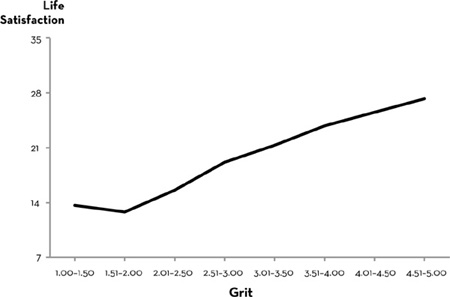
the grittier a person is, the more likely they’ll enjoy a healthy emotional life. Even at the top of the Grit Scale, grit went hand in hand with well-being, no matter how I measured it.
Intrapersonal character includes grit. This cluster of virtues also includes self-control, particularly as it relates to resisting temptations like texting and video games.
Interpersonal character includes gratitude, social intelligence, and self-control over emotions like anger. These virtues help you get along with—and provide assistance to—other people.
intellectual character includes virtues like curiosity and zest. These encourage active and open engagement with the world of ideas.
We all face limits—not just in talent, but in opportunity. But more often than we think, our limits are self-imposed. We try, fail, and conclude we’ve bumped our heads against the ceiling of possibility. Or maybe after taking just a few steps we change direction. In either case, we never venture as far as we might have.
To be gritty is to keep putting one foot in front of the other. To be gritty is to hold fast to an interesting and purposeful goal. To be gritty is to invest, day after week after year, in challenging practice. To be gritty is to fall down seven times, and rise eight
I’ve laid out the words as I heard them—as a poem:
The challenge of writing
Is to see your horribleness on page.
To see your terribleness
And then to go to bed.
And wake up the next day,
And take that horribleness and that terribleness,
And refine it,
And make it not so terrible and not so horrible.
And then to go to bed again.
And come the next day,
And refine it a little bit more,
And make it not so bad.
And then to go to bed the next day.
And do it again,
And make it maybe average.
And then one more time,
If you’re lucky,
Maybe you get to good.
And if you’ve done that,
That’s a success.
If you define genius as being able to accomplish great things in life without effort, then he was right: I’m no genius, and neither is he.
But if, instead, you define genius as working toward excellence, ceaselessly, with every element of your being—then, in fact, my dad is a genius, and so am I, and so is Coates, and, if you’re willing, so are you.